Alienation
Being and NothingnessAlienation names the inescapable exterior dimension of human existence: through the freedom of others, a person becomes an object and acquires a being that cannot be recovered as self-knowledge or brought fully under personal control. It reaches from the look that alters a person’s possibilities, through the body as it exists for others, to the social meanings assigned to a situation; in death, this exposure becomes definitive, as the living inherit authority over the dead person’s meaning.
The Look and the Exterior Self
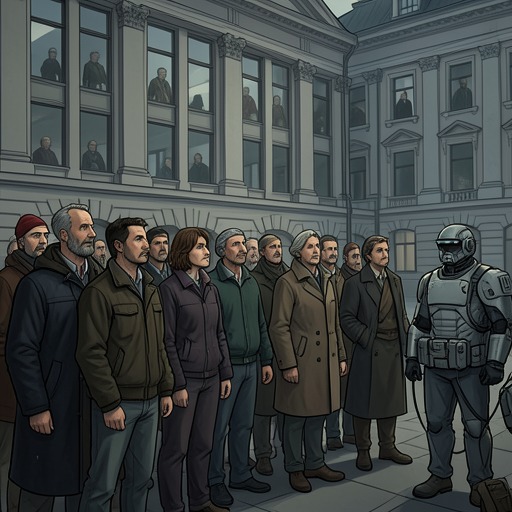
Shame and pride disclose the self as it exists for another. Shame is not primarily knowledge about being watched; it is the lived recognition of being the object another sees and judges. In that encounter, the self’s freedom escapes into an outside it cannot inspect, while the world around it—the walls, the door, even the keyhole—seems to turn toward the other. The world no longer flows only from the self’s own center of reference. It flows toward the other, and the self finds itself outside itself, exposed in a world that is at once its own and beyond its grasp.
What the other sees is not a transparent portrait the self can simply confirm or correct. The self is this being for the other, but its character remains indeterminate because it is written in another freedom. The other’s look therefore confers a nature from outside lived freedom: shame or pride is the apprehension of being a nature, even though that nature is not directly knowable to the person who bears it. The other’s freedom appears precisely in this uncertainty. What the self is for the other is not one of its own possibilities that it can choose and master, but a limit it carries without being able to turn around and survey it.
Possibilities Reorganized by Another
The look does more than make the self an object: it reorganizes the situation in which the self acts. A dark corner may appear to the person alone as a possibility of hiding, its darkness inviting concealment. Under another’s look, the same corner enters a different network of relations: the other might illuminate it, discover the person, and turn hiding into a means of finding or arresting them. The person’s possibility remains theirs in one sense, yet it is also taken up as an instrument in the other’s world—an obstacle the other may overcome, or a means that may serve the other’s ends.
This is why alienation affects the world as well as the self. To be seen as seated is to be seen as seated on a chair; to be seen bent over is to be seen bent over the keyhole. The person’s relation to the chair or keyhole can no longer be lived as though it belonged only to their own practical perspective. The other’s look gives the objects a new organization, with different relations and distances, while their aspects for the person become secret or inaccessible. The shock of being looked at is thus an alienation of possibilities associated with objects across a world that has acquired another center.
The other’s presence also turns possibility into probability: the person begins to apprehend their own possible actions as possibilities another may calculate, anticipate, or surpass. They do not thereby see exactly what the other will do; what confronts them is the uncertainty of their possibilities in the other’s hands. Alienation is not the simple disappearance of agency. The person still lives their possibilities, but can no longer claim that those possibilities belong exclusively to a world they organize alone.
The Stranger One Is for Others
The self that returns from another’s look is still the self, but metamorphosed by a new setting. When another calls someone evil, jealous, sympathetic, or antipathetic, the person may know that the description concerns them without recognizing it as an inner truth they can possess. They can accept responsibility for this stranger presented as themselves without ceasing to experience it as strange. Being-for-others is not a piece of self-knowledge, nor an image the other alone invents: it is a real dimension of being that escapes the self even as it belongs to them.
That escape is lived as uneasiness. The other is not merely an idea used to complete one’s knowledge of oneself; the other’s presence is an encounter with a strange freedom, inseparable from the experience of being wrenched away from oneself. The person feels exposed to a world that is familiar yet no longer fully theirs. Even when language supplies a name for a quality, it does not give the person direct possession of that quality. A description can indicate what the person is for another, while leaving that being at a distance, to be lived through shame, fear, or unease rather than grasped as an object within the self.
The Body’s Inaccessible Outside
The body makes this structure concrete. It is first lived by the person, and it is also used and known by others; in the third dimension of its being, the person exists for themselves as a body known by another. The encounter does not simply add an outside description to an otherwise self-contained body. It discloses that the person’s bodily facticity already has an exterior dimension, one that escapes the intimate experience through which the person lives the body.
A doctor listening to someone’s breathing illustrates how the other’s perspective rearranges bodily experience. The doctor’s ear, itself perceived, indicates that the person’s body is being apprehended by another body. What the person lives from within becomes designated as a thing in a world that is not theirs alone. Their body appears as an instrument among instruments, and their senses as something another may apprehend, even though the person cannot take up that other perspective on their own senses. The result is not a view of the whole external arrangement but an awareness that the body has an outside the person cannot survey.
Shyness expresses this alienation without making the alienated body available. The shy person’s uneasiness concerns the body as it is for another, not the body as lived from within. Attempts to manage that external appearance cannot secure it: the very actions meant to shape the body for others may themselves escape the person and become part of what is fixed at a distance. The body-for-others remains inapprehensible, yet its inaccessibility can constrain. The longing to be invisible is therefore directed toward this alienated dimension, not toward abolishing the lived body.
Knowledge and language do not close the gap. A person may use concepts received from others to understand an illness reflectively, but those concepts organize a quasi-object rather than replacing the body as it is lived. Cognitive knowledge of the body incorporates an external point of view; its knowable structures indicate alienation without allowing the person to inhabit that perspective directly. What language makes available is a way of signifying the body’s exterior dimension, not a way to make that dimension wholly one’s own.
Situation, Recognition, and Freedom
Alienation is also the limit of freedom in a situation. A prohibition may confront someone as an expression of an alien will, but its force in that person’s lived world depends on the choices through which they respond to it. The more fundamental limit arises because another can apprehend the person as an object and the person’s situation as an objective structure. The situation thus has an outside that the person cannot remove, just as being-for-others places an exterior limit on being-for-itself.
This exteriority is not a new obstruction encountered midway through action, nor a brute resistance inside the situation. It escapes direct intuition: it is the situation’s being outside for others. Each chosen situation is consequently liable to exist as a form for another, with a face the chooser did not choose. Freedom cannot escape this condition without escaping situated existence itself. The limit is not simply a wall in freedom’s path, but a centrifugal dimension through which what freedom undertakes can also exist for another as something outside its control.
Yet this limit is not intelligible apart from freedom. The other can limit the person only as a freedom, and the person can experience that limit by recognizing the other’s freedom and assuming their own being-for-others. The discussion makes the point through the example of being Jewish in relation to antisemites: recognizing their freedom and assuming that social identity are bound together in the person’s experience of an external limit. If the other is treated as a mere object, that particular being-for-others disappears from view and the person apprehends themselves instead as unqualifiable freedom. Alienation is therefore neither abolished by choice nor simply received as a fixed inner property; its meaning is assumed in a relation between freedoms.
Death and the Final Transfer of Meaning
While a person lives, the meaning of their life remains in suspense. They can criticize and transform what they have been by projecting toward new ends; others may define them, but they can continue to exceed those definitions through action. Death closes that power of inward change. The dead person’s life may still change in meaning, but those changes now come from outside, without the dead person’s participation or responsibility.
The example of an apostle of peace clarifies what is at stake. While alive, this figure can claim that there will be no war and retain the power to define the meaning of the undertaking. If the project reaches beyond individual existence into a situation such as peace in Europe, death dispossesses the apostle of authority over whether the effort will be understood as folly, failure, or insight. The change is not merely a final judgment added to an otherwise completed life: it is the transfer of that life’s meaning to others.
Death therefore makes alienation irreversible. During life, a person may escape an identity assigned by others by projecting new ends, although the other may take them up again in another judgment. Neither side permanently settles the struggle. Death suppresses the person’s ability to answer, leaving the living with the final interpretive advantage. The dead person does not persist merely as a collection of memories: their being-for-others remains a real, objective existence in the human world, reduced to exteriority and carried forward through others’ histories. Alienation thus spans the ordinary look and the final condition of the dead: the self’s outside is always real, but only death makes it the self’s sole remaining dimension.